Posted by Red Barn Tradition on 21st Sep 2026
Tallow Soap vs. Coconut Oil Soap: What’s the Difference?
Tallow Soap vs. Coconut Oil Soap: What’s the Difference?
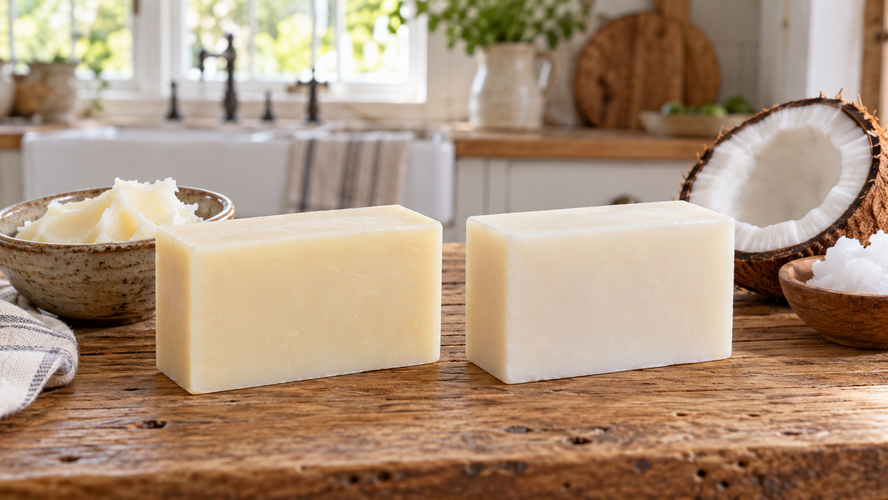
Two familiar soapmaking fats, two different styles of lather, and two very different ways to shape the character of a bar.
Tallow and coconut oil are two common fats used in handmade soap, but they contribute very different characteristics to a formula.
Both can produce excellent soap when formulated properly.
Both undergo the same basic process of saponification.
And both may appear either as the main fat in a recipe or as part of a larger blend.
So why would a soapmaker choose one over the other?
Understanding what each ingredient contributes helps explain why Red Barn Tradition builds its core soap collection around grass-fed beef tallow.
Both Tallow and Coconut Oil Become Soap
Soap is produced when fats or oils react with an alkali such as sodium hydroxide.
During this process, called saponification, the original fats are chemically transformed.
Both beef tallow and coconut oil can participate in this reaction.
However, their fatty-acid profiles differ.
That means they behave differently in finished soap.
The choice of fat affects hardness, lather, cleansing characteristics, and how a bar feels during use.
What Tallow Brings to Soap
Grass-fed beef tallow forms the foundation of many Red Barn soaps.
We value it because it contributes:
✓ Firmness
✓ Durability
✓ Dense, creamy lather
✓ A substantial bar
✓ Good everyday longevity when kept dry
Tallow bars tend to have a traditional, sturdy character. That is one of the reasons the ingredient fits Red Barn so naturally.
What Coconut Oil Brings to Soap
Coconut oil is widely used in soapmaking because it can create a hard bar and contributes abundant bubbly lather.
It is especially effective at producing the kind of larger foam many consumers associate with cleansing products.
For this reason, coconut oil often appears in blended soap formulas alongside other fats and oils.
Used appropriately, it can be a valuable ingredient.
The exact experience depends on how much is used and how the overall recipe is balanced.
Creamy Lather vs. Bubbly Lather
The difference in lather is one of the easiest characteristics to notice.
Tallow: associated with a richer, creamier foam.
Coconut oil: associated with larger, more abundant bubbles.
Neither is automatically better.
Some customers love big bubbles. Others prefer the dense creaminess of a traditional tallow bar.
More bubbles do not automatically mean better soap.
Both Can Create Hard Bars
Tallow and coconut oil can both contribute firmness.
However, they do so as part of formulas with different overall properties.
Bar quality still depends on the complete recipe, how accurately it was formulated, how it was processed, and how long it was cured.
A hard bar is desirable for durability, but hardness is only one part of making good soap.
Lather, cleansing balance, usability, and storage matter too.
Why Formulation Matters So Much
One ingredient cannot tell you everything about a bar.
A soap may contain coconut oil at a relatively modest amount within a larger blend.
Another may rely heavily on it.
Likewise, a tallow bar may be nearly all tallow or may combine tallow with additional oils.
These differences can significantly change performance.
A good soapmaker designs the formula as a whole.
What About Cleansing?
Coconut oil is known in soap formulation for producing strong cleansing characteristics, particularly when used at higher percentages.
That makes formulation especially important.
Soapmakers can balance a recipe in various ways depending on the intended product.
Tallow provides a different fatty-acid profile and creates a different washing experience.
Red Barn has chosen to center tallow because its creamy lather, hardness, and traditional character align with the bar we want to make.
Can Tallow and Coconut Oil Be Used Together?
Yes.
Many handmade soap recipes combine them.
A soapmaker might use tallow for firmness and creamy lather while using coconut oil to increase larger bubbles.
This is a common example of why soap formulations frequently contain more than one fat.
Different ingredients can complement one another.
However, a soap does not need coconut oil simply because it is common. A maker can formulate around different priorities.
Why Red Barn Focuses on Tallow
Our brand is centered on traditional skin goods.
We wanted the foundation of our soap collection to reflect that identity.
Grass-fed beef tallow became that foundation.
✓ A strong connection to traditional soapmaking
✓ A firm bar
✓ Creamy lather
✓ A rustic character
✓ A consistent base for unscented and scented soaps
That makes it the natural centerpiece of Red Barn’s soap line.
Which One Should You Choose?
Coconut-Oil-Containing Soap May Appeal to You If:
✓ You particularly enjoy abundant bubbly lather
✓ You like larger foam during washing
✓ You enjoy blended soap formulations
Tallow Soap May Appeal to You If:
✓ You want a sturdy traditional bar
✓ You prefer dense, creamy lather
✓ You appreciate traditional soapmaking ingredients
✓ You want a practical everyday soap
There is no universal winner. The complete formula matters more than a single ingredient.
Quality also depends on production, curing, storage, and how the soap fits your personal routine.
How Storage Affects Either Type
No matter what fats a soap contains, leaving the bar in standing water will shorten its life.
1. Use a well-draining soap dish.
2. Let the bar dry between washes.
3. Avoid storing it directly under continuous shower spray.
4. Keep unused bars in a cool, dry place with reasonable airflow.
These practices are particularly useful with handcrafted soap because they help preserve the characteristics the soapmaker worked to create.
Different Ingredients, Different Traditions
One of the pleasures of handmade soap is discovering how ingredients change the finished bar.
Tallow creates one experience.
Coconut oil creates another.
Olive oil creates another.
A blended formula can combine several.
There does not need to be only one correct approach.
For Red Barn Tradition, grass-fed tallow gives us exactly the foundation we want.
Traditional.
Firm.
Creamy.
Useful.
Designed for everyday life.
If you want to experience that difference yourself, begin with our Pure Grass-Fed Unscented Tallow Soap and explore the rest of the Red Barn collection from there.
Experience the Red Barn Tallow Difference
Start with our Pure Grass-Fed Unscented Tallow Soap or explore the full handcrafted Red Barn collection.
SHOP TALLOW SOAP