
Posted by Red Barn Tradition on 2nd Sep 2026
Tallow Soap vs. Commercial Soap: What’s the Difference?
Tallow Soap vs. Commercial Soap: What’s the Difference?
Walk down the soap aisle of almost any store and you will find dozens of options.
Bright bottles. Colorful bars. Body washes. Cleansing bars. Moisturizing formulas. Fragrances of every kind.
Then there is traditional handmade soap.
At first glance, they may all seem to serve the same basic purpose: helping you get clean. But the way they are made, the ingredients they contain, and the experience they provide can be very different.
So what exactly makes handcrafted tallow soap different from many commercially produced soaps?
The answer begins with how soap is made.
Traditional Soap Is Created Through Saponification
Traditional soap is made through a chemical process called saponification.
During this process, fats or oils are combined with an alkali, usually sodium hydroxide for hard bar soap. When the ingredients are carefully measured and blended together, they react and transform into soap.
Tallow is one of the traditional fats that can be used in this process.
At Red Barn Tradition, grass-fed beef tallow forms the foundation of many of our handcrafted soap bars. Tallow has been used in soapmaking for generations because it helps produce a firm, durable bar with a rich, creamy lather.
Once the soap is poured, cut, and properly cured, the result is a finished bar designed for everyday washing.
Many Commercial Cleansing Bars Are Made Differently
Not every product that looks like a traditional bar of soap is made the same way.
Some commercially manufactured cleansing bars rely heavily on synthetic surfactants or detergent-based ingredients rather than traditional soapmaking alone. Others may combine traditional soap with additional ingredients designed to change the texture, fragrance, appearance, shelf life, or performance of the finished product.
That does not mean commercial cleansing bars are automatically bad.
They are simply designed with different priorities.
Large manufacturers may need products that remain extremely consistent from batch to batch, withstand long storage periods, travel through large distribution systems, and maintain the same color, scent, texture, and appearance for long periods of time.
Handmade soap is generally produced on a much smaller scale.
Ingredient Lists Can Look Very Different
One of the first things shoppers often notice when comparing handmade soap with commercial products is the ingredient list.
A traditional tallow soap can begin with a very simple foundation.
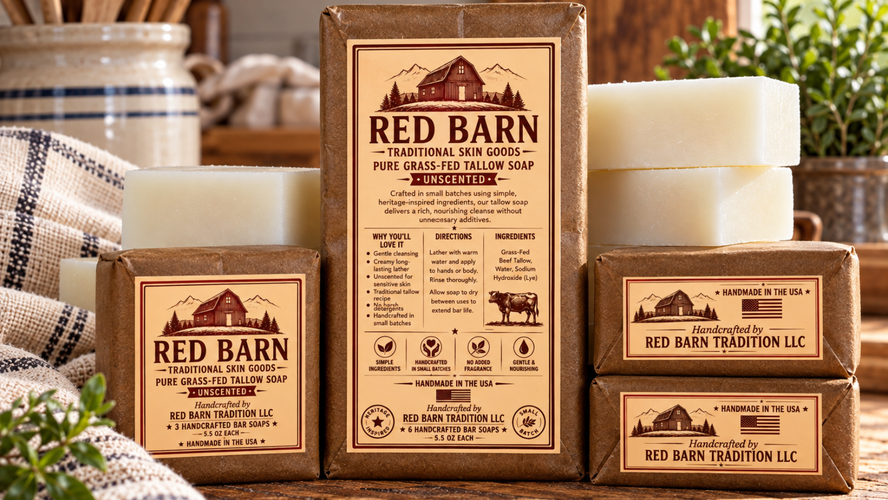
For example, Red Barn’s Pure Grass-Fed Unscented Tallow Soap is built around traditional soapmaking ingredients such as:
- Grass-fed beef tallow
- Distilled water
- Sodium hydroxide
Other handcrafted varieties may include additional ingredients such as essential oils, fragrance, colloidal oatmeal, goat milk, honey, activated charcoal, sea salt, coffee, turmeric, or other carefully selected additions.
Commercial cleansing products may contain longer ingredient lists because they are formulated for different manufacturing and performance goals.
For customers who enjoy understanding what goes into the products they use every day, the straightforward nature of handmade soap can be especially appealing.
Handmade Soap Is Produced in Smaller Batches
Another major difference is scale.
Commercial soap and body wash may be manufactured in enormous quantities using highly automated equipment.
Handcrafted soap is typically made in much smaller batches.
At Red Barn, the soapmaking process includes measuring ingredients, blending the batch, pouring it into molds, removing the soap, cutting individual bars, curing them, inspecting the finished bars, and preparing them for customers.
That hands-on approach is part of what makes small-batch soap different.
You may occasionally notice small variations in color, shape, texture, or appearance from one handmade bar to another.
Those subtle differences are not necessarily flaws.
They are part of the character of a handcrafted product.
Handmade Soap Needs Time to Cure
Traditional cold-process soap also requires something that cannot be rushed easily:
time.
After the soap has been made and cut, the bars are placed in a well-ventilated area to cure.
During the curing period, excess water gradually evaporates from the bars. As the soap cures, it becomes harder and more durable.
A well-cured bar generally lasts longer in use than a freshly made bar because it contains less water.
This is one reason handmade soap is not simply mixed, cut, packaged, and shipped on the same day.
Traditional soapmaking requires patience.
At Red Barn, we appreciate that slower process because it reflects the kind of products we want to make: useful goods created with care rather than rushed through production.
Why Tallow Makes Such a Good Soap Bar
Different fats and oils contribute different qualities to soap.
Grass-fed beef tallow is especially valued because it helps create a bar that is:
- Firm and durable
- Smooth in the hand
- Creamy when lathered
- Well suited for everyday washing
- Long lasting when properly stored
Tallow soap generally produces a dense, creamy lather instead of disappearing quickly after only a few uses.
The life of the bar also depends heavily on how it is stored.
Allowing your soap to dry between uses on a well-draining soap dish can make a significant difference in how long it lasts.
Bar Soap vs. Body Wash
Body wash has become a familiar part of many modern bathrooms.
It is convenient, widely available, and comes in countless formulas and fragrances.
Traditional bar soap offers a different kind of simplicity.
A bar takes up very little space.
There is no large bottle sitting in the shower.
It is easy to pack for travel.
It can be stored neatly in a linen closet.
And once the bar is completely used, there is very little left behind.
For customers who want to simplify their bathroom routine, returning to traditional bar soap can feel surprisingly refreshing.
Does Handmade Automatically Mean Better?
Not necessarily.
“Handmade” simply describes how a product is produced. The quality of any soap depends on the formula, ingredients, craftsmanship, curing process, and proper handling.
Likewise, commercial products can be well formulated and useful for many people.
The better question is:
What kind of product do you prefer?
Some people value convenience and consistency above everything else.
Others enjoy small-batch products, traditional ingredients, simple formulas, and the story behind how something was made.
Neither choice has to be complicated.
Why Some Customers Are Returning to Traditional Soap
Part of the growing interest in traditional bar soap may come from a broader desire for simplicity.
Modern homes are filled with specialized products.
One for the face.
One for the hands.
One for the shower.
Another for travel.
Another for the guest bathroom.
Traditional soap represents a much older idea: make a dependable product, use it well, and let it serve its purpose.
That practical philosophy is at the heart of Red Barn Tradition.
We are inspired by products that feel familiar, useful, rustic, and thoughtfully made.
The Red Barn Difference
For us, tallow soap is more than simply another product to place on a shelf.
It connects modern soapmaking with a long tradition of creating useful household goods from practical ingredients.
Our grass-fed tallow soaps are handcrafted in small batches and allowed the time they need before they are prepared for customers.
Some bars are completely unscented.
Others feature rustic, fresh, warm, or woodsy scent combinations.
But they all begin with the same philosophy:
Keep everyday goods simple, useful, and rooted in tradition.
Try Traditional Tallow Soap for Yourself
If you have only used commercial cleansing bars or bottled body wash, trying a handcrafted tallow soap can offer a very different experience.
A great place to begin is our Pure Grass-Fed Unscented Tallow Soap.
From there, you can explore other Red Barn varieties and discover the scents and ingredients that best fit your home and daily routine.
Visit RedBarnTradition.com to explore our handcrafted traditional skin goods.