Posted by Red Barn Tradition on 16th Sep 2026
Tallow Soap vs. Goat Milk Soap: What’s the Difference?
Tallow Soap vs. Goat Milk Soap: What’s the Difference?
Two familiar traditional ingredients, two different roles in soapmaking—and sometimes both belong in the same bar.
Tallow soap and goat milk soap are both popular in the handmade soap world, but the comparison can be confusing.
There is an important reason why:
Tallow and goat milk are not actually equivalent ingredients.
Tallow is primarily a soapmaking fat.
Goat milk is generally used as the liquid portion or as an additional ingredient within a soap formula.
In fact, one bar can contain both.
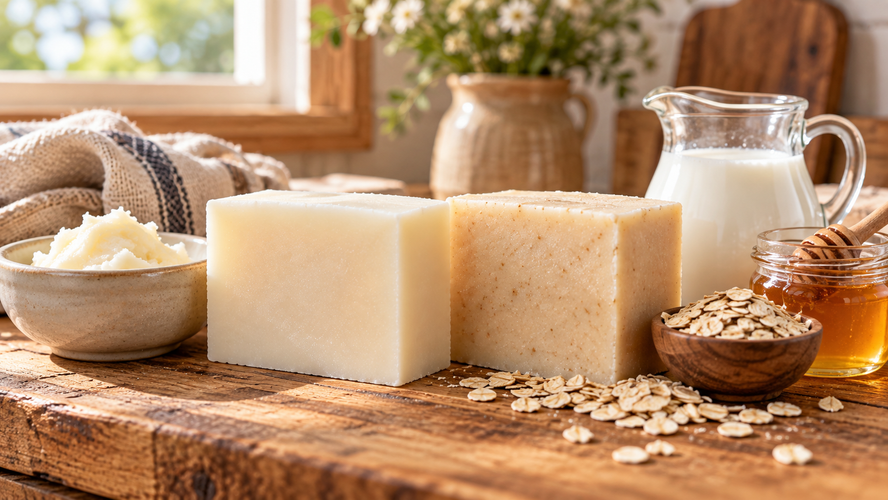
Red Barn’s Oatmeal Goat Milk & Honey Tallow Soap is a perfect example.
Understanding this distinction makes comparing the two much easier.
What Is Tallow Soap?
Tallow soap uses rendered animal fat—most commonly beef tallow—as one of the primary fats in the soap formula.
At Red Barn Tradition, grass-fed beef tallow forms the foundation of many of our bars.
Tallow is especially valued because it contributes:
✓ Bar hardness
✓ Durability
✓ Creamy lather
✓ A substantial feel
✓ Good longevity when properly stored
The fat reacts with sodium hydroxide during saponification to form soap.
What Is Goat Milk Soap?
Goat milk soap is soap made using goat milk somewhere in the formula.
In many recipes, goat milk replaces some or all of the water normally used to prepare the soap.
However, goat milk is not typically the primary soapmaking fat.
The formula still needs fats or oils.
Those might include tallow, olive oil, coconut oil, or a blend.
“Goat milk soap” describes one feature of the formulation rather than telling you everything about the bar.
Can Soap Be Both?
Absolutely.
This is where many shoppers get confused.
A soap can be both tallow soap and goat milk soap.
For example, Red Barn’s Oatmeal Goat Milk & Honey bar combines grass-fed beef tallow with goat milk as part of the formula.
Asking whether tallow soap or goat milk soap is better is a little like asking whether bread should contain flour or milk. They can serve different roles within the same recipe.
How Does Tallow Affect the Bar?
Tallow primarily influences the structure and lather of the soap.
It helps produce a firm bar that stands up well to everyday handling.
That hardness can contribute to longer use when the bar is stored properly.
Tallow also contributes a dense, creamy lather. These characteristics make it an excellent foundation for traditional bar soap.
How Does Goat Milk Change the Recipe?
Adding goat milk changes the formulation and character of the bar.
It can affect color, texture, processing, and how the soapmaker manages the batch.
Milk soaps often have a warm, traditional appearance that fits especially well with farmhouse-style soap collections.
At Red Barn, goat milk pairs naturally with oatmeal and honey to create a bar with a distinctly cozy, rustic identity.
What About Oatmeal and Honey?
When goat milk is combined with additional ingredients, the soap takes on an even more specific personality.
Oatmeal contributes visual and textural character.
Honey complements the farmhouse-inspired formula.
Together with goat milk and grass-fed tallow, those ingredients create a bar that feels very different from Red Barn’s simple Unscented Tallow Soap. That variety is part of the benefit of starting with a dependable tallow foundation.
Which Has Simpler Ingredients?
That depends entirely on the individual formula.
A Pure Tallow Soap can be extremely straightforward.
A goat milk soap may also be relatively simple, but it usually includes goat milk in addition to the fats and alkali required to make soap.
Some goat milk soaps contain numerous oils, fragrances, colors, or botanicals. Others do not.
The label matters more than the product name alone.
What About Scent?
Neither tallow nor goat milk automatically determines whether a soap is scented.
Tallow soap can be unscented or scented.
Goat milk soap can be unscented or scented.
For shoppers who want to avoid added fragrance, checking the individual ingredient list is important.
At Red Barn, our Pure Grass-Fed Tallow Soap provides an unscented option, while other varieties offer different scent experiences.
Which One Should You Choose?
Instead of thinking about the choice as tallow versus goat milk, think about what kind of bar you want.
Choose a Straightforward Tallow Bar If You Prefer:
✓ A simple traditional formula
✓ An unscented option
✓ A firm everyday bar
✓ A clear introduction to tallow soap
Consider Tallow + Goat Milk If You Prefer:
✓ A more complex farmhouse-style bar
✓ Additional ingredients such as oatmeal and honey
✓ A different visual and sensory experience
✓ More traditional pantry-inspired ingredients
Neither approach has to replace the other.
Why Red Barn Offers Both
We want Red Barn customers to have choices without losing the traditional identity of the collection.
That is why grass-fed tallow remains our foundation while individual formulas can take different directions.
Our Unscented Tallow Soap shows tallow in one of its simplest forms.
Our Oatmeal Goat Milk & Honey Tallow Soap shows what happens when that same traditional foundation is combined with additional farmhouse-inspired ingredients.
Both belong naturally within Red Barn Tradition.
Two Traditional Ingredients, One Useful Bar
The most important takeaway is simple:
Tallow soap and goat milk soap are not necessarily competing categories.
They can complement one another.
Tallow provides the fat foundation.
Goat milk can become part of the liquid and overall formulation.
Together, they can create a distinctive handmade soap.
Understanding the ingredients helps customers choose based on what they actually want rather than relying only on the product name.
Explore Red Barn’s Tallow Soap Collection
Discover our Pure Grass-Fed Unscented Tallow Soap and Oatmeal Goat Milk & Honey Tallow Soap, along with the rest of our handcrafted collection.
SHOP TALLOW SOAP