Posted by Red Barn Tradition on 17th Sep 2026
Tallow Soap vs. Olive Oil Soap: How Are They Different?
Tallow Soap vs. Olive Oil Soap: How Are They Different?
Two traditional soapmaking fats, two different bar experiences, and a long history behind both.
Tallow and olive oil have both been used in soapmaking for generations.
Yet they create noticeably different kinds of bars.
One comes from rendered animal fat.
The other comes from olives.
Both can be used to make traditional soap, and both have long histories in household and artisan soapmaking.
So what is the difference between tallow soap and olive oil soap?
The answer comes down largely to the properties each fat contributes to the finished bar.
Tallow and Olive Oil Are Both Soapmaking Fats
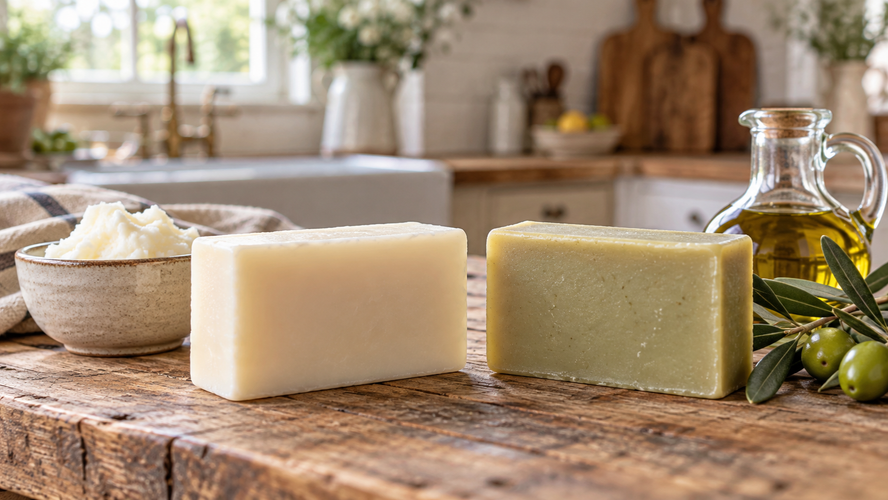
Unlike the comparison between tallow and goat milk, tallow and olive oil serve similar fundamental roles in soap formulation.
Both provide fatty acids that react with sodium hydroxide during saponification.
That means a soapmaker can create formulas built primarily around tallow, primarily around olive oil, or around a combination of the two.
Different fats create different qualities in soap, which is why formulation matters.
What Does Tallow Contribute?
Tallow is valued for creating a firm, durable bar.
At Red Barn Tradition, grass-fed beef tallow is the foundation of many of our soaps because it contributes characteristics that fit our approach particularly well.
Tallow soap tends to offer:
✓ Firmness
✓ Durability
✓ Dense, creamy lather
✓ A substantial feel in the hand
✓ Good longevity when kept dry
These properties make it well suited to an everyday traditional soap.
What Does Olive Oil Contribute?
Olive oil is another classic soapmaking ingredient with a long history, particularly in Mediterranean soap traditions.
Soap made with a very high percentage of olive oil is often associated with Castile-style soap.
Olive-oil-heavy bars behave differently from tallow bars.
They may begin softer and typically benefit from a substantial cure.
The lather can also have a different character from a tallow-based formula.
Rather than assuming one is superior, it is more useful to understand that the two ingredients create different soap experiences.
Hardness and Cure Time
One of the most obvious differences is bar development.
Tallow naturally contributes hardness.
Olive-oil-heavy soaps can require a longer period to develop the kind of firmness many soap users expect.
That does not make olive oil soap inferior.
It simply means the formulation and curing process may be different.
This demonstrates why curing is such an important part of traditional soapmaking. The finished experience depends on more than simply mixing ingredients together.
Lather Differences
Lather is another area where people notice differences.
Tallow contributes a dense, creamy foam.
Olive-oil-dominant soaps can produce a lower-bubble, more lotion-like or slippery lather depending on the recipe and age of the bar.
Some people prefer one style. Others enjoy both.
Personal preference matters. Soap does not need enormous bubbles to do its basic job.
Can Tallow and Olive Oil Be Used Together?
Yes.
Soapmakers often combine fats and oils in order to balance characteristics.
A formulation may use one ingredient for hardness, another for lather, and another to change texture or processing.
Tallow and olive oil do not have to be competitors.
They can be complementary ingredients.
At Red Barn, however, we have chosen to make grass-fed tallow the defining foundation of our core soap identity.
Which Is More Traditional?
Both are traditional.
Their historical use simply reflects different geographic resources and cultures.
In areas where livestock fats were readily available, tallow became practical.
In regions with abundant olive production, olive oil became a natural soapmaking resource.
Traditional soapmaking has never been defined by one universal fat.
People generally used the resources that made sense where they lived. That is part of what makes soap history so interesting.
What About Ingredient Simplicity?
Both tallow and olive oil soaps can be made with straightforward formulas.
Simple tallow soap: tallow, water, and sodium hydroxide.
Simple olive oil soap: olive oil, water, and sodium hydroxide.
Additional ingredients depend on the maker.
Neither ingredient automatically means the soap will have a longer or shorter ingredient list.
Which One Lasts Longer?
There is no universal answer because bar size, formula, cure time, frequency of use, and storage all matter.
A well-cured tallow bar can be very durable because tallow contributes hardness.
A mature olive-oil-heavy bar can also become quite firm.
Regardless of formulation, allowing soap to dry between uses is one of the most effective ways to extend its life.
Which Should You Try?
Tallow Soap May Appeal to You If You Prefer:
✓ A firm traditional bar
✓ Dense, creamy lather
✓ A substantial feel
✓ A straightforward everyday soap
Olive Oil Soap May Appeal to You If You Prefer:
✓ A classic olive-oil soap tradition
✓ A different style of lather
✓ A bar that develops over a longer cure
✓ Exploring another traditional soapmaking path
There is no need to turn the comparison into a competition. Traditional soapmaking has room for both.
Why Red Barn Centers Tallow
At Red Barn Tradition, we wanted one recognizable ingredient to connect our soap collection.
Grass-fed beef tallow became that ingredient.
It gives our bars a strong foundation.
It suits our rustic, traditional identity.
And it performs in the way we want our everyday soap to perform.
That does not diminish the value of other traditional soapmaking oils.
It simply defines our approach.
Two Traditional Paths to Soap
Tallow and olive oil demonstrate one of the most interesting aspects of soapmaking:
There are many ways to create a good bar.
Different regions developed different traditions.
Different makers developed different formulas.
Different customers developed different preferences.
At Red Barn, our path begins with grass-fed tallow.
For customers curious about traditional bar soap, our Pure Grass-Fed Unscented Tallow Soap is a simple place to experience that foundation for yourself.
Experience the Red Barn Tallow Tradition
Explore our handcrafted grass-fed tallow soaps, including our Pure Grass-Fed Unscented Tallow Soap.
SHOP TALLOW SOAP