Posted by Red Barn Tradition on 7th Sep 2026
The History of Tallow Soap: A Traditional Craft That Still Matters Today
The History of Tallow Soap: A Traditional Craft That Still Matters Today
Tallow soap may feel like a modern rediscovery, but it is actually part of a very old soapmaking tradition.
Long before bathrooms were filled with plastic bottles, specialized cleansers, and endless personal-care products, people relied on simple materials they already had available. Animal fats, plant oils, water, ash-derived alkalis, and later refined lye became the foundation of practical household soapmaking.
Beef tallow played an important role in that history.
At Red Barn Tradition, that connection to older methods is part of what makes tallow soap meaningful to us. We are not trying to recreate the past exactly as it was. We are taking inspiration from a traditional craft and bringing it into a modern everyday routine.
Soapmaking Goes Back Thousands of Years
Humans have been making soap-like cleansing materials for thousands of years.
Early soapmaking methods varied widely depending on the region, available ingredients, and local customs. Some mixtures used animal fats, while others relied on plant oils.
The chemistry behind soap was not always fully understood, but people discovered that combining fats with alkaline substances could create something useful for cleaning.
Over time, soapmaking became more refined.
Recipes improved.
Ingredients became more predictable.
And soap gradually became a common household necessity.
Why Animal Fats Were Used
Before global supply chains and modern manufacturing, people worked with what they had.
Animal fats were valuable household resources.
Instead of discarding them, families often rendered and reused them for cooking, candles, lubrication, and soapmaking.
Tallow—rendered fat from cattle or other ruminant animals—was especially useful because of the hardness and durability it contributed to soap.
This made it practical for homes where products needed to last and materials were not wasted casually.
That practicality is one of the reasons tallow remained an important soapmaking ingredient for generations.
What Made Tallow Good for Soap?
Different fats behave differently in soap.
Tallow became valued because it could help create a bar that was firm, long-lasting, and pleasant to use.
Those qualities mattered in everyday life.
A soap bar had to survive repeated use.
It had to hold its shape.
It needed to clean effectively.
And it had to be practical enough to make from available household materials.
Tallow fit those needs well.
Even today, many soapmakers appreciate it for similar reasons.
Soap Was Once a Household Skill
There was a time when soapmaking was not a hobby or niche craft.
For many households, it was simply part of life.
People made soap because they needed it.
The process required knowledge, caution, patience, and experience. Recipes were often passed down informally, and results could vary depending on the ingredients available.
Modern soapmakers have major advantages that earlier generations did not always have.
Today, we can measure ingredients accurately, calculate formulas precisely, understand saponification scientifically, and use purified sodium hydroxide rather than relying on less predictable homemade alkalis.
That makes modern traditional soapmaking far more controlled and consistent.
The Shift Toward Commercial Soap
As manufacturing became more industrialized, soap production gradually moved away from the home and small workshop.
Large manufacturers could produce enormous quantities of soap with consistent appearance, fragrance, packaging, and shelf life.
Later, liquid body washes and synthetic detergent-based cleansing bars became common as well.
Convenience became the new standard.
For many households, buying soap became far easier than making it.
Over time, traditional soapmaking became less necessary as a household skill.
But it never disappeared.
Why Handmade Soap Came Back
In recent years, there has been renewed interest in handmade goods and traditional methods.
People are increasingly curious about how everyday products are made.
They want to know what ingredients are used.
They enjoy buying directly from small makers.
And many appreciate goods that feel more personal than something produced by the millions.
Handmade soap fits naturally into that movement.
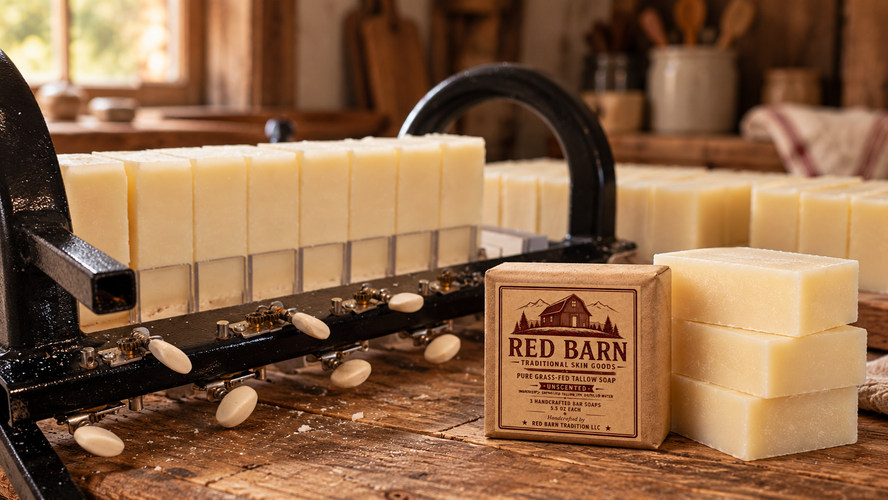
A handcrafted soap bar may look simple, but it carries a visible connection to the process behind it.
The batch was measured.
The soap was mixed.
It was poured.
It was cut.
It was cured.
And it was prepared by hand.
That process gives the finished bar a character that is difficult to reproduce through industrial manufacturing.
Tallow Soap and the Idea of Using Resources Well
One of the most interesting parts of tallow soap history is the philosophy behind it.
Traditional households used resources carefully.
Materials had value.
Fats were not automatically discarded simply because they were by-products of food preparation or farming.
They were transformed into something useful.
That idea still resonates today.
Tallow soap reflects a practical approach: take a usable material, prepare it carefully, and turn it into something that serves a real purpose.
For Red Barn, that makes tallow especially fitting.
It is traditional not simply because it is old, but because it reflects a mindset centered on usefulness and care.
Traditional Does Not Mean Primitive
There is an important distinction to make.
Modern traditional soapmaking is not the same as recreating every historical method exactly as it was practiced generations ago.
Today, soapmakers benefit from better equipment, improved safety practices, more precise measurements, and a much stronger understanding of chemistry.
That matters.
Traditional soapmaking can honor older methods while still using modern standards.
At Red Barn Tradition, we appreciate the history, but we also value consistency, careful formulation, and responsible production.
Why Tallow Soap Still Makes Sense Today
Tallow soap remains relevant because the qualities that made it useful historically are still useful now.
A good tallow soap bar can be:
- Firm
- Durable
- Creamy in lather
- Easy to store
- Easy to travel with
- Well suited for everyday use
- Long lasting when kept dry
Those are not outdated qualities.
They are practical qualities.
And practical products do not stop being useful simply because newer products exist.
The Return to Simple Household Goods
There is something appealing about returning to simple products.
A bar of soap.
A wooden brush.
A cast-iron pan.
A linen towel.
A handmade candle.
These items are ordinary, but they can feel meaningful when they are made thoughtfully and used fully.
Tallow soap fits beautifully into that kind of home.
It is not about rejecting modern life.
It is about choosing a product that connects daily routines with a longer tradition of craftsmanship.
How Red Barn Carries That Tradition Forward
At Red Barn Tradition, we are inspired by the idea that everyday goods can still be made with care.
Our grass-fed tallow soaps are handcrafted in small batches using traditional soapmaking principles.
Some are simple and unscented.
Others include distinctive ingredients and scent combinations such as Pine Tar, Lavender Cedarwood, Spearmint Eucalyptus, Coffee, Sea Salt & Activated Charcoal, and Oatmeal Goat Milk & Honey.
The formulas may vary, but the foundation remains the same:
Create useful products.
Respect the process.
Let them take the time they need.
And make something people can genuinely use every day.
An Old Craft With a Place in Modern Life
The history of tallow soap is really a history of practical living.
People used what they had.
They learned how to transform simple materials.
They created products that served their homes.
Today, we have more choices than ever.
But sometimes the older ideas are still worth keeping.
That is why tallow soap continues to have a place at Red Barn Tradition.
It connects the past with the present in one simple, useful bar.
Visit RedBarnTradition.com to explore our handcrafted tallow soaps and traditional skin goods.