
Posted by Red Barn Tradition on 10th Sep 2026
What Does Handmade Soap Really Mean?
What Does Handmade Soap Really Mean?
The phrase handmade soap appears everywhere.
You may see it at farmers markets, online shops, craft fairs, small boutiques, or on product labels. But what does “handmade” actually mean when it comes to soap?
At its simplest, handmade soap is soap produced in smaller batches with direct involvement from the maker rather than being manufactured entirely through large-scale automated production.
But there is more to it than that.
Handmade soap is also about process, variation, ingredient choices, curing time, and the kind of attention that goes into turning a formula into a finished bar.
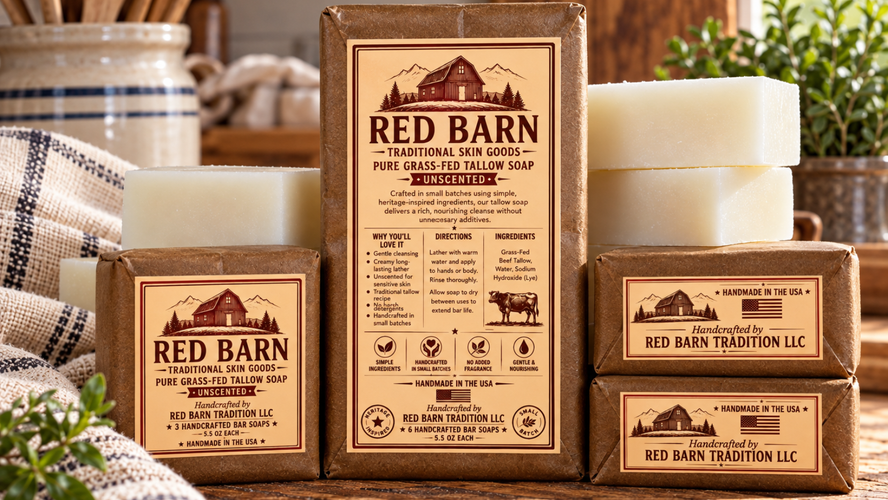
At Red Barn Tradition, handmade means our soap is not just designed to look rustic. It is physically measured, mixed, poured, cut, cured, inspected, and prepared as a small-batch product.
Handmade Does Not Mean Homemade in a Casual Sense
One common misconception is that “handmade” means something informal or imprecise.
Good handmade soapmaking is actually highly structured.
A soapmaker must work with exact measurements.
The amount of sodium hydroxide must be calculated correctly for the fats and oils being used.
Temperatures must be considered.
Ingredients must be weighed.
The batch must be mixed properly.
And the finished soap must be given enough time to cure.
So while handmade soap may be produced on a smaller scale, it should still be made with careful formulation and consistent methods.
Small-Batch Production Is Part of the Difference
One of the biggest differences between handmade soap and mass-produced soap is scale.
Commercial manufacturers may produce enormous numbers of bars with highly automated equipment.
Handmade soap is generally created in much smaller batches.
That smaller scale gives the maker more direct contact with the process.
At Red Barn, that can include:
- Preparing ingredients
- Measuring the formula
- Mixing the batch
- Pouring the soap
- Removing it from the mold
- Cutting the bars
- Allowing them to cure
- Inspecting each batch
- Preparing bars for packaging and shipment
That hands-on process is part of what customers are choosing when they buy handmade.
Handmade Soap Can Look Slightly Different
If you are used to factory-made products, you may expect every soap bar to look exactly the same.
Perfectly identical color.
Perfectly identical shape.
Perfectly identical texture.
Handmade soap does not always work that way.
Small differences can occur from one batch to another.
The color may vary slightly.
The surface may be a little different.
A cut may not look perfectly identical to the next bar.
Natural ingredients can also behave differently depending on the batch.
Those variations are part of the handcrafted character of the product.
They do not necessarily mean something is wrong.
They often show that the product was actually made in smaller batches rather than being stamped out by industrial machinery.
Handmade Soap Still Depends on Chemistry
Even though handmade soap is a craft, it is also chemistry.
Traditional soap is created through a process called saponification.
During saponification, fats or oils react with sodium hydroxide and are transformed into soap.
That means a soapmaker cannot simply improvise ingredients without understanding how they interact.
Each fat has its own saponification value, which affects how much sodium hydroxide is needed in the recipe.
Careful calculations are essential.
This is one reason responsible handmade soapmaking requires more than creativity.
It requires precision.
Why Curing Time Matters
A freshly cut soap bar is not necessarily ready for use.
Cold-process handmade soap needs time to cure.
During curing, excess water gradually evaporates from the bar.
As moisture leaves, the soap becomes harder and more durable.
This process helps create a bar that can last longer during everyday use.
Curing is one of the clearest examples of why handmade soap cannot always be rushed.
You can mix a batch in one day.
You can cut it shortly afterward.
But the finished product still needs time.
That waiting period is part of the craft.
Handmade Soap Gives Makers More Ingredient Choices
Small-batch soapmaking also gives the maker flexibility in choosing ingredients.
At Red Barn Tradition, grass-fed beef tallow forms the foundation of many of our soaps.
From there, different recipes may include ingredients or scent profiles such as:
- Pine tar
- Pine essential oil
- Colloidal oatmeal
- Goat milk
- Honey
- Coffee
- Lavender
- Cedarwood
- Spearmint
- Eucalyptus
- Sea salt
- Activated charcoal
- Turmeric
- Sandalwood
- Patchouli
This allows individual bars to have very different personalities while still belonging to the same Red Barn collection.
Handmade Does Not Automatically Mean Better
The word “handmade” is not a guarantee of quality by itself.
A handmade product can be poorly formulated just as a commercial product can be well formulated.
What matters is how the product is made.
Good handmade soap should come from a sound formula, careful measurements, appropriate curing, responsible ingredient handling, and consistent production practices.
That distinction is important.
At Red Barn, we want “handmade” to describe the real process behind the product, not simply serve as a marketing word.
What Customers Often Appreciate About Handmade Soap
People choose handmade soap for many different reasons.
Some enjoy supporting a small business.
Some appreciate simpler formulas.
Some like traditional ingredients.
Others enjoy the look, feel, scent, or character of a handcrafted bar.
Many simply want something that feels different from the products lining a large store shelf.
Handmade soap can make an ordinary routine feel a little more intentional.
It is still soap.
It is still meant to be used.
But the process behind it gives the product a different kind of story.
Handmade Soap and Everyday Use
One of the things we like most about traditional soap is that it is not meant to sit untouched.
It belongs in real life.
Beside the sink.
In the shower.
In the guest bathroom.
Packed into a travel bag.
Placed in a gift basket.
Stored in the linen closet until the next bar is needed.
Handmade does not need to mean delicate or decorative.
A well-made handcrafted bar should be practical enough for everyday use.
Why Handmade Fits Red Barn
Red Barn Tradition is centered around useful goods with a traditional character.
That makes handmade soap a natural fit.
We like the process.
We like the patience involved.
We like seeing a batch go from individual ingredients to a finished bar.
We like that small variations remind us the product was physically made and handled.
And we like that something as ordinary as soap can still carry craftsmanship behind it.
Handmade Is About the Process
So what does handmade soap really mean?
It means there was a process behind the bar.
Someone measured the ingredients.
Someone mixed the batch.
Someone poured the soap.
Someone cut it.
Someone gave it time to cure.
Someone inspected it before it was prepared for the customer.
That process does not make handmade soap automatically superior to every commercial product.
But it does make it different.
For people who value traditional methods, small-batch craftsmanship, and products that feel connected to the person or business that made them, that difference matters.
At Red Barn Tradition, handmade is not a decoration.
It is how the soap gets from our worktable to your home.
Visit RedBarnTradition.com to explore our handcrafted tallow soaps and traditional skin goods.