Posted by Red Barn Tradition on 11th Sep 2026
What Makes a Quality Handmade Soap Bar?
Here is Blog #10 fully prepared for BigCommerce, continuing the same Red Barn style and SEO structure.
What Makes a Quality Handmade Soap Bar?
Not all handmade soap is created the same way.
Two bars may both be labeled “handmade,” yet they can differ significantly in formulation, curing time, texture, scent, hardness, and overall performance.
That is because quality handmade soap depends on more than appearance.
A good bar begins with a sound formula, carefully chosen ingredients, accurate measurements, proper soapmaking technique, enough curing time, and thoughtful storage.
At Red Barn Tradition, we believe quality should be something you can experience in the way a bar feels, lathers, lasts, and fits into everyday use.
Here are some of the characteristics that help define a well-made handmade soap bar.
A Good Formula Comes First
Soapmaking starts with chemistry.
Traditional bar soap is created when fats or oils react with sodium hydroxide through a process called saponification.
Each fat and oil has different properties, and each requires a specific amount of sodium hydroxide.
That means a quality bar begins with a carefully calculated formula.
The soapmaker has to understand how the chosen ingredients will affect the finished product.
Some fats contribute hardness.
Some influence lather.
Some affect how quickly a bar wears down.
Some change the texture or character of the soap.
At Red Barn, grass-fed beef tallow forms the foundation of many of our bars because it helps create the kind of soap we want to offer: firm, durable, creamy, and practical for everyday use.
Quality Ingredients Matter
A soap formula is only as good as the ingredients used to make it.
That does not mean every bar needs a long or complicated ingredient list.
In fact, a straightforward formula can be excellent when the ingredients are chosen intentionally.
Many Red Barn soaps begin with grass-fed beef tallow, water, and sodium hydroxide.
Depending on the variety, additional ingredients may include oatmeal, goat milk, honey, pine tar, essential oils, charcoal, salt, or other ingredients that contribute to the bar’s identity.
The goal is not to add ingredients simply to make a product sound more impressive.
Each ingredient should have a reason for being there.
Proper Measurements Are Essential
Handmade soap should never be made by guessing.
Because soapmaking relies on a chemical reaction, measurements matter.
Too much or too little of a key ingredient can affect the finished bar.
Responsible soapmaking requires the ingredients to be weighed carefully and the formula to be followed accurately.
This is one reason quality handmade soap is both a craft and a technical process.
Creativity matters, but precision matters just as much.
A Quality Bar Should Be Properly Cured
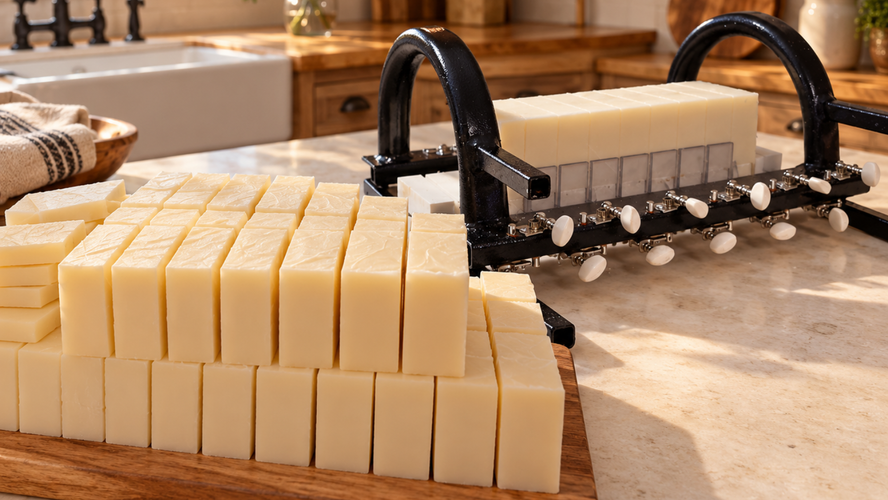
Curing time is one of the most important characteristics of traditional cold-process soap.
A freshly cut bar may look finished, but it still needs time.
During curing, excess water gradually evaporates from the soap.
As this happens, the bar becomes harder and more durable.
That matters because a harder bar generally lasts longer during use than a very fresh, water-rich bar.
Curing also gives the finished product time to develop into the form the soapmaker intended.
This is one part of the process that cannot simply be skipped for convenience.
Good handmade soap requires patience.
Hardness Is an Important Quality
A quality bar should usually feel substantial in the hand.
That does not mean every soap must be rock hard, but a properly cured bar should not feel excessively soft or dissolve immediately when exposed to water.
This is one of the qualities tallow contributes especially well.
Grass-fed beef tallow helps create a firm bar that holds its shape nicely.
When the soap is also kept dry between uses, that firmness helps extend the life of the bar.
That makes proper storage just as important as proper manufacturing.
The Lather Should Fit the Formula
People often assume a good soap must produce enormous bubbles.
That is not necessarily true.
Different soap formulas create different types of lather.
Some produce larger bubbles.
Others create a dense, creamy foam.
Tallow is known for contributing a rich, creamy lather.
For Red Barn, that fits the traditional character of the soap very well.
The goal is not to make every bar behave like bottled body wash.
It is to create a satisfying washing experience that reflects the ingredients used.
Appearance Can Tell You Something, But Not Everything
Handmade soap can be beautiful.
Swirls, natural colors, rustic textures, visible oatmeal, charcoal, salt, and different shapes can all add character to a bar.
But appearance alone does not determine quality.
A perfectly photographed soap bar can still be poorly formulated.
Likewise, a simple-looking cream-colored bar can be exceptionally well made.
That is why we think customers should look beyond the surface.
The formula, ingredients, curing process, and performance of the bar matter more than decoration alone.
Slight Variation Is Normal
Handmade soap does not always look mechanically identical.
One bar may be slightly darker than another.
The surface texture may vary.
Natural ingredients can create subtle differences between batches.
A cut may be slightly different from the next.
These small variations are part of small-batch soapmaking.
They do not automatically indicate poor quality.
In many cases, they are simply a reminder that the soap was mixed, poured, cut, and handled by people rather than stamped out by a machine.
Scent Should Match the Product
For scented soap, fragrance plays a major role in the experience.
A quality scented bar should have a fragrance that fits the identity of the soap rather than overpowering everything else.
At Red Barn, different scent profiles are designed to give each bar its own personality.
Pine Tar feels rugged and outdoorsy.
Lavender Cedarwood feels softer and woodsy.
Spearmint Eucalyptus feels fresh and crisp.
Coffee has a warm, familiar character.
Unscented soap offers something entirely different.
Quality does not mean one scent is better than another.
It means the scent choice makes sense for the bar and is used thoughtfully.
A Quality Bar Should Be Practical
Handmade soap should still be useful.
It should not feel so delicate or decorative that you are afraid to actually use it.
A well-made bar belongs in everyday life.
In the shower.
Beside the kitchen sink.
In the guest bathroom.
In a travel bag.
In a cabin.
In a gift basket.
The best handmade soap combines craftsmanship with practicality.
That is one of the values at the center of Red Barn Tradition.
Storage Affects Quality After Purchase
Even a beautifully made bar can wear down quickly if it is stored incorrectly.
Water is the enemy of bar longevity.
If soap sits in standing water, it can soften much faster.
The easiest solution is simple:
Use a well-draining soap dish and allow the bar to dry between uses.
Good airflow helps preserve the firmness of the soap and can noticeably extend its life.
Unused bars should also be stored somewhere cool, dry, and well ventilated.
Handmade Does Not Automatically Mean High Quality
The word “handmade” is not a guarantee by itself.
A quality handmade bar depends on the maker’s formula, ingredients, process, curing, and attention to detail.
The same is true in the opposite direction.
A commercially produced product is not automatically poor quality simply because it was made on a larger scale.
What matters is how well the product was designed for its intended purpose.
For customers interested in traditional soap, small-batch production offers something distinctive: a more direct connection between the maker, the process, and the finished product.
What We Look for at Red Barn
For Red Barn Tradition, a quality soap bar should be:
- Properly formulated
- Carefully measured
- Well cured
- Firm and durable
- Pleasant to use
- Practical for everyday life
- Consistent with the ingredients and scent profile
- Handled and prepared with care
We also want the bar to reflect the larger Red Barn philosophy.
Simple.
Useful.
Traditional.
Made with purpose.
Quality Is More Than a Pretty Bar
A beautiful label can attract attention.
A rustic photograph can tell a story.
But true quality happens before the soap ever reaches the customer.
It happens when the formula is calculated.
When the ingredients are measured.
When the batch is mixed.
When the soap is cut.
When the bars are given enough time to cure.
And when the finished product is inspected and prepared carefully.
That is what turns a simple bar into a product worth using every day.
If you are new to traditional tallow soap, our Pure Grass-Fed Unscented Tallow Soap is a straightforward place to begin.
Visit RedBarnTradition.com to explore our handcrafted tallow soaps and traditional skin goods.