Posted by Red Barn Tradition on 7th Oct 2026
Why Goat Milk Has a Place in Traditional Soapmaking
Why Goat Milk Has a Place in Traditional Soapmaking
A familiar farmhouse ingredient with a long connection to handcrafted soap and traditional household goods.
Goat milk and handmade soap have been connected for generations.
Today, goat milk soap is often marketed as something new or luxurious, but the idea fits into a much older pattern of traditional soapmaking:
Use practical ingredients that are available and turn them into useful household goods.
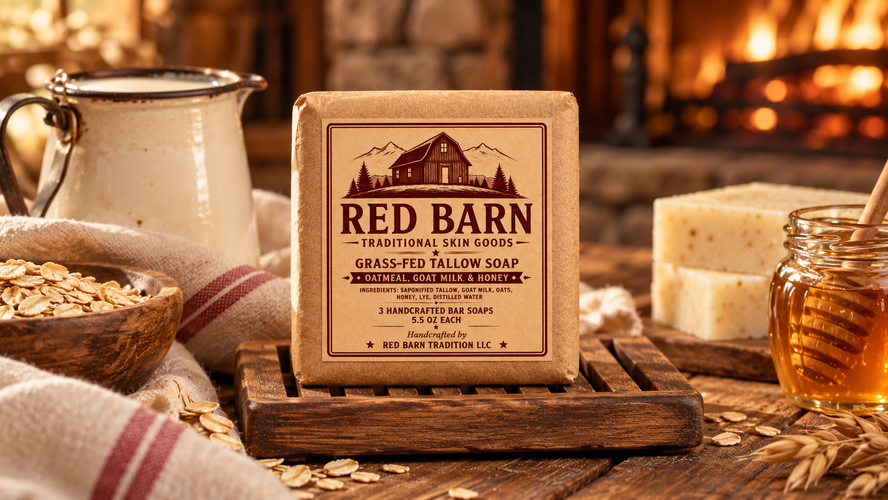
At Red Barn Tradition, goat milk appears in our Oatmeal Goat Milk & Honey Tallow Soap, where it works alongside grass-fed beef tallow, oatmeal, and honey to create a bar with a warm farmhouse character.
Goat milk soap and tallow soap are not opposites. A bar can be both.
Goat Milk Is Not the Main Soapmaking Fat
Traditional hard soap requires fats or oils.
At Red Barn, grass-fed beef tallow provides that foundation in many of our formulas.
Goat milk plays a different role.
It becomes part of the liquid portion of the soap formulation.
Tallow describes the fat foundation.
Goat milk describes another ingredient used within the formula.
That distinction matters because customers sometimes compare “tallow soap” and “goat milk soap” as though they are mutually exclusive categories. They are not.
Why Milk Appears in Handmade Soap
Milk has long been incorporated into artisan soap formulas.
Different makers use cow milk, goat milk, or other milk ingredients depending on the recipe.
Goat milk is especially common because of its strong association with small farms, homesteading, and traditional handcrafted goods.
Familiar.
Practical.
Rural.
Traditional.
For Red Barn, that identity makes it a natural fit.
It Creates a Distinct Product Identity
One of the benefits of using goat milk is that it immediately changes how a soap is perceived.
Pure Grass-Fed Unscented Tallow Soap
Minimal, simple, and straightforward.
Oatmeal Goat Milk & Honey Tallow Soap
More layered, warm, and farmhouse-inspired.
Both begin with tallow, but goat milk, oatmeal, and honey give the second bar a completely different personality.
Goat Milk Works Naturally With Oatmeal
Some ingredients seem made for one another.
Goat milk and oatmeal are a good example.
Both have a soft, traditional household character.
Neither feels overly modern or artificial.
Together, they create a soap that fits naturally into rustic bathrooms, farmhouse kitchens, guest rooms, and gift baskets.
Add honey, and the combination feels even more cohesive.
Why We Pair It With Honey
Honey gives the formula another familiar pantry-style ingredient.
Visually and conceptually, it connects beautifully with goat milk and oatmeal.
These are ingredients most people recognize immediately.
Oatmeal. Goat Milk. Honey. Tallow.
There is no mystery about the intended character. The name almost explains the bar by itself.
Goat Milk Soap Fits Fall Especially Well
Although goat milk soap can be used year-round, fall is an especially natural season for it.
Its light cream tones work beautifully with:
Rustic wood
Cream linen
Amber glass
Honey
Oats
Warm kitchen lighting
Neutral fall décor
That makes the bar an easy addition to autumn product photography and gift sets.
A Strong Guest Bathroom Choice
Goat milk soap is also a natural fit for a guest bathroom.
It feels traditional and welcoming without having the darker, more rugged personality of Pine Tar.
For Thanksgiving preparation, place an Oatmeal Goat Milk & Honey bar on a wooden draining dish beside cream hand towels.
The setup is simple, useful, and seasonal without being overly decorated.
A Thoughtful Hostess Gift
This soap also works especially well as a fall hostess gift.
Natural sponge
Wooden soap dish
Linen towel
Small honey jar
Simple kraft packaging
That is enough to create a gift that feels coordinated and useful.
Handmade Soap Still Requires Careful Formulation
Traditional ingredients do not eliminate the need for modern precision.
Soapmaking is chemistry.
Recipes must be calculated accurately.
Ingredients must be weighed.
The soap must be processed correctly.
Finished bars need appropriate curing time.
This matters regardless of whether the formula includes goat milk, tallow, oatmeal, honey, or other traditional materials.
Why Traditional Ingredients Still Appeal Today
Modern consumers have access to thousands of highly specialized products.
Yet ingredients such as goat milk continue to attract interest.
Part of the reason may simply be familiarity.
People like knowing what an ingredient is.
They like products connected to recognizable materials.
They appreciate goods that feel closer to traditional household practices than industrial formulas.
Goat milk fits naturally into that preference.
Traditional Does Not Mean Primitive
Red Barn’s approach is not about pretending modern soapmaking knowledge does not exist.
It is about combining traditional inspiration with contemporary understanding.
Appreciate ingredients with historical roots.
Measure accurately.
Formulate carefully.
Maintain consistent production methods.
That is the best of both worlds.
Why Goat Milk Belongs at Red Barn
The ingredient fits our brand because Red Barn is not built around flashy trends.
It is built around warm, useful, traditional products.
Goat milk contributes to that story.
Combined with grass-fed tallow, oatmeal, and honey, it creates one of the most farmhouse-inspired soaps in our collection.
And that makes it especially fitting as fall settles in.
Discover Goat Milk in a Traditional Tallow Soap
Explore Oatmeal Goat Milk & Honey Tallow Soap and the rest of the Red Barn handcrafted grass-fed tallow soap collection.
SHOP TALLOW SOAP