
Posted by Red Barn Tradition on 18th Sep 2026
Why Handmade Soap Feels Different From Store-Bought Soap
Why Handmade Soap Feels Different From Store-Bought Soap
Small-batch craftsmanship, traditional ingredients, and the slower rhythm of handmade soap.
A bar of soap may seem like one of the simplest products in the home.
Pick it up, add water, create a lather, wash, and rinse.
Yet people who switch from mass-produced cleansing products to traditional handmade soap often notice that the experience feels different.
The bar may feel firmer.
The lather may be creamier.
The appearance may vary slightly from one batch to another.
And the soap may have been mixed, poured, cut, cured, and prepared by hand.
At Red Barn Tradition, those differences are part of what we appreciate about traditional soapmaking.
It Starts With the Formula
Handmade soap is created through saponification, the chemical reaction that occurs when fats or oils are combined with an alkali such as sodium hydroxide.
The fats chosen by the soapmaker have a significant effect on the finished product.
At Red Barn Tradition, grass-fed beef tallow forms the foundation of many of our handcrafted soaps.
Tallow contributes qualities such as:
✓ Firmness
✓ Durability
✓ Dense, creamy lather
✓ A substantial feel in the hand
✓ Good longevity when stored properly
Other fats and oils produce different results. That means the way a handmade soap feels begins long before the bar reaches the bathroom.
It begins with the formula.
Handmade Soap Is Produced on a Smaller Scale
One of the most obvious differences between handmade and large-scale commercial soap is how the product is made.
Commercial manufacturers may produce enormous quantities of cleansing products using highly automated equipment.
Handcrafted soap is generally made in smaller batches.
At Red Barn, the process can include measuring ingredients, preparing the tallow, mixing the soap batter, pouring it into molds, cutting the bars, curing them, inspecting the finished soap, and preparing customer orders.
There is much more direct involvement with each batch.
That hands-on process is part of what customers are choosing when they purchase a small-batch product.
The Lather Can Feel Different
Many modern cleansing products are designed to produce abundant foam.
Because people often associate bubbles with cleaning, it is easy to assume that more bubbles automatically mean better soap.
That is not necessarily the case.
Different soapmaking fats produce different types of lather.
Tallow is especially known for contributing a dense, creamy foam.
Rather than creating only large airy bubbles, a traditional tallow soap can produce a richer, more substantial lather.
The Bar May Feel More Substantial
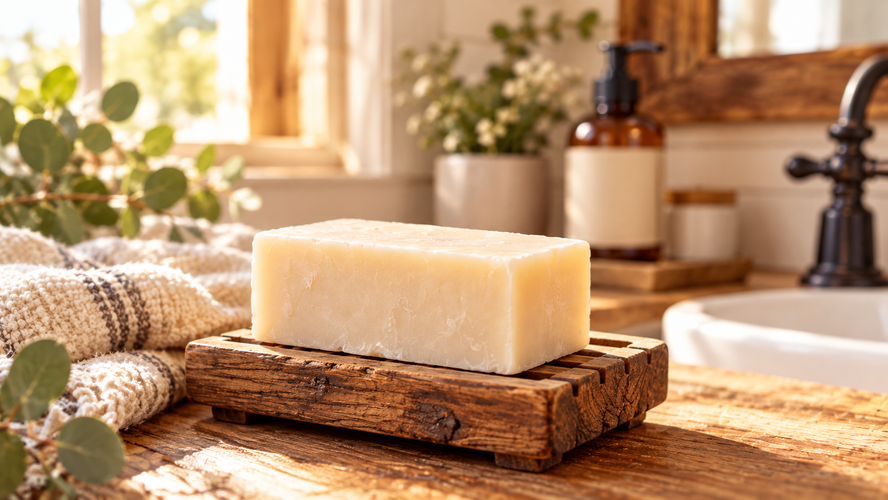
A properly formulated and cured tallow soap develops significant firmness.
That gives it a satisfying weight and structure when held in the hand.
A hard bar can also withstand repeated use well when it is allowed to dry between washes.
Using a well-draining soap dish and allowing airflow around the bar helps preserve its firmness.
Handmade Soap Needs Time
Another major difference is curing.
Cold-process soap does not simply go from mixing bowl to shipping box.
After the soap is made and cut, the bars require time to cure.
During this period, excess water gradually evaporates and the soap becomes harder.
The process is a good reminder that some products simply cannot be rushed without changing the result.
Measure.
Mix.
Pour.
Cut.
Cure.
Then prepare the finished soap.
Natural Variation Is Part of the Experience
Mass-produced products are usually designed to look almost perfectly identical.
Handmade soap can show subtle differences.
One batch may be slightly lighter or darker.
A surface may have a little more texture.
An ingredient may distribute slightly differently.
Even the individual cuts can show small variations.
That does not automatically indicate a quality problem.
It is often simply part of producing products on a smaller scale.
At Red Barn, we want consistency in our formulas and quality while still allowing our soap to look like what it is: a handcrafted product.
Ingredients Create Character
Handmade soap also gives makers room to create bars with distinct personalities.
Unscented Tallow Soap feels simple and straightforward.
Pine Tar feels rugged and woodsy.
Oatmeal Goat Milk & Honey carries a warm farmhouse character.
Lavender Cedarwood offers a softer aromatic direction.
Activated Charcoal creates a dramatically different appearance from a pale traditional tallow bar.
These differences come from the formula rather than simply from changing the packaging.
A dependable traditional foundation can become several distinct products.
Handmade Does Not Mean Automatically Better
It is important to keep the comparison realistic.
Something being handmade does not automatically make it superior to every commercially manufactured product.
Quality still depends on formulation, craftsmanship, ingredients, proper curing, and production practices.
Commercial products can be excellent.
Handmade products can be poorly made.
The word itself is not enough.
For Red Barn, “handmade” matters because it accurately describes how we work. It is about process rather than simply marketing.
Why People Are Returning to Handmade Goods
There seems to be renewed appreciation for goods with visible craftsmanship behind them.
Handmade bread.
Candles.
Pottery.
Woodworking.
Soap.
People enjoy understanding how products are made and supporting the businesses that make them.
Soap is particularly interesting because it combines craftsmanship with something extremely ordinary.
It becomes part of everyday life.
A Simple Difference You Can Experience
The best way to understand handmade soap is simply to use it.
Pick up the bar.
Create a lather.
Notice the firmness.
Allow it to dry.
Use it again the next day.
A handmade tallow soap does not need to be complicated to feel distinctive.
The difference is often found in the small things: the texture, the creamy lather, the slight variation, and the knowledge that the bar went through a hands-on process before it reached your home.
If you are new to Red Barn Tradition, our Pure Grass-Fed Unscented Tallow Soap is a simple place to start.
Experience Handmade Tallow Soap
Discover small-batch grass-fed tallow soaps rooted in traditional craftsmanship and made for the everyday rhythm of home.
SHOP TALLOW SOAP