
Posted by Red Barn Tradition on 3rd Sep 2026
How Traditional Tallow Soap Is Made
How Traditional Tallow Soap Is Made
A finished bar of handmade soap may look simple, but behind every bar is a carefully controlled process involving precise measurements, chemistry, time, and patience.
Traditional tallow soap is made through a soapmaking method that has been used for generations. At Red Barn Tradition, that process reflects exactly what we value: practical ingredients, small-batch craftsmanship, and everyday products made with care.
If you have ever wondered how beef tallow becomes a finished bar of soap, here is a closer look at the process.
Step 1: Start With Quality Tallow
The process begins with beef tallow.
Tallow is rendered beef fat that has been carefully prepared and purified for use. In traditional soapmaking, tallow is valued because it helps produce a hard, durable bar with a dense, creamy lather.
At Red Barn Tradition, grass-fed beef tallow forms the foundation of many of our handcrafted soaps.
The fat used in a soap recipe matters because different fats and oils contribute different characteristics to the finished bar. Tallow is especially useful when the goal is a sturdy, long-lasting soap designed for everyday use.
Step 2: Measure the Soap Formula Carefully
Traditional soapmaking is not something that can be done by guessing.
Each type of fat requires a specific amount of sodium hydroxide to turn it into soap. Because of that, soapmakers calculate and measure their formulas carefully before the batch begins.
Every ingredient must be weighed accurately.
That includes the tallow, liquid, sodium hydroxide, and any other ingredients included in the formula.
Precision is one of the most important parts of soapmaking because the chemistry depends on the correct proportions.
A beautiful finished bar begins with careful preparation.
Step 3: Prepare the Lye Solution
Sodium hydroxide, commonly known as lye, is an essential ingredient in traditional hard bar soap.
During soapmaking, sodium hydroxide is carefully combined with liquid according to the recipe.
Before the soapmaking reaction occurs, sodium hydroxide is caustic and must be handled with proper precautions.
However, lye is not simply added to the soap and left unchanged.
When it is combined with fats in the correct proportions, a chemical reaction called saponification occurs.
During saponification, the fats and sodium hydroxide react and transform into soap.
That transformation is what makes traditional soapmaking possible.
Step 4: Prepare the Tallow
The tallow must also be brought to the proper condition before it is combined with the lye solution.
Depending on the recipe and process, the tallow may need to be gently warmed until it is completely melted and ready for mixing.
At this point, the soapmaker is paying close attention to temperature, measurements, and timing.
Soapmaking combines craftsmanship with chemistry, and even a simple-looking bar requires careful control throughout the process.
Step 5: Combine the Tallow and Lye Solution
Once everything is ready, the prepared fats and lye solution are combined.
As the ingredients are blended together, the mixture begins to change.
It slowly becomes thicker and more uniform as the soapmaking process progresses.
Soapmakers often refer to a particular stage of thickening as trace.
At trace, the mixture has emulsified and has begun developing the consistency needed before it is poured into a mold.
It is one of the most recognizable stages of cold-process soapmaking.
Step 6: Add Additional Ingredients
Not every tallow soap needs additional ingredients.
A simple unscented bar can remain beautifully straightforward.
Other recipes, however, may include ingredients that give the finished soap its own character.
Depending on the formula, Red Barn soaps may feature ingredients or scent profiles such as:
- Pine tar
- Pine essential oil
- Colloidal oatmeal
- Goat milk
- Honey
- Coffee
- Lavender
- Cedarwood
- Spearmint
- Eucalyptus
- Activated charcoal
- Sea salt
- Turmeric
- Sandalwood
- Patchouli
These ingredients can influence the soap’s appearance, aroma, texture, and overall personality.
That is one of the things we enjoy most about soapmaking.
The same traditional tallow foundation can become several very different bars.
Step 7: Pour the Soap Into Molds
Once the soap batter reaches the proper stage, it is poured into molds.
The mold gives the soap its basic shape while the mixture continues to firm.
At this stage, the soap is still very fresh.
It has not yet developed the hardness or durability of a cured bar.
The soap remains in the mold until it is firm enough to remove safely and cut into individual bars.
Step 8: Cut the Soap Into Bars
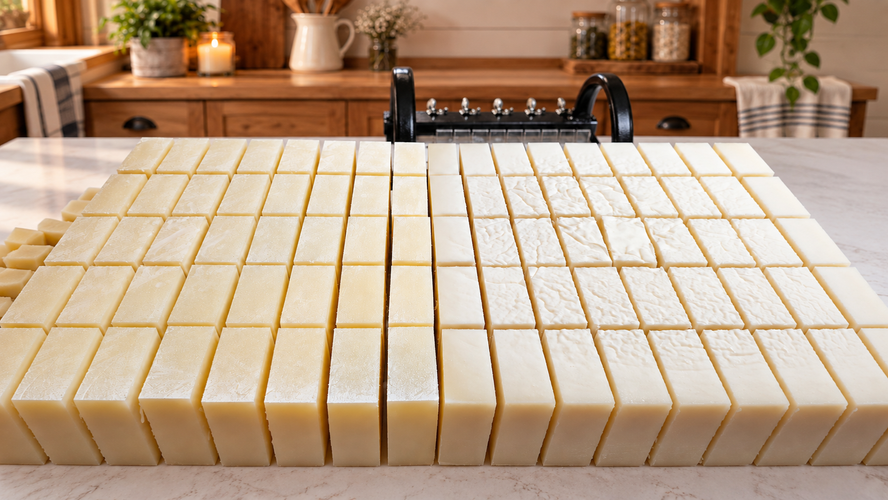
For many soapmakers, cutting a fresh loaf is one of the most satisfying parts of the entire process.
Once the soap is ready, the loaf is removed from the mold and divided into individual bars.
At Red Barn, our handmade process means each bar may have slight natural differences.
A small variation in color, shape, surface texture, or appearance can occur from one batch to another.
That is part of the character of small-batch soap.
Handcrafted does not always mean mechanically identical.
It means each batch has been physically made, cut, handled, and prepared rather than produced as part of a massive automated manufacturing line.
Step 9: Let the Soap Cure
Cutting the soap does not mean the process is finished.
Cold-process soap needs time to cure.
Freshly cut bars are placed in an area where air can circulate around them.
During the curing period, excess water gradually evaporates from the bars.
As this happens, the soap becomes harder and more durable.
A harder bar generally lasts longer during use, especially when it is allowed to dry between washes.
This curing period is one of the biggest differences between handmade cold-process soap and products designed for rapid large-scale manufacturing.
Good traditional soap requires patience.
Why Curing Matters
It can be tempting to think that a soap bar is finished as soon as it becomes solid enough to cut.
But curing plays an important role in the finished product.
As moisture leaves the bar, the soap becomes firmer.
That helps create a bar that is easier to handle and slower to dissolve during everyday use.
Once the soap reaches the customer, proper storage continues to matter.
Keeping a bar on a well-draining soap dish and allowing it to dry between uses can help extend its life significantly.
Step 10: Inspect and Prepare the Finished Bars
Once the curing period is complete, the finished soap can be inspected and prepared for customers.
Bars are checked before they move on to packaging and fulfillment.
Then comes another favorite part of the Red Barn process: preparing customer orders and sending handmade soap to homes across the country.
What began as individual ingredients has now become a finished everyday product.
Why We Do Not Rush the Process
Modern manufacturing is often built around speed.
Make more.
Package faster.
Ship sooner.
Traditional soapmaking follows a different rhythm.
Measure carefully.
Mix carefully.
Pour.
Cut.
Cure.
Wait.
Then prepare the finished product.
That slower approach fits naturally with Red Barn Tradition.
We believe useful everyday goods do not need to be rushed simply because the modern world moves quickly.
From Our Soap Table to Your Home
Every handcrafted tallow soap bar begins with simple ingredients.
Through saponification, cutting, curing, and careful preparation, those ingredients become something practical that can be used every day.
That transformation is what makes traditional soapmaking so satisfying.
It is a process rooted in chemistry, craftsmanship, and patience.
And even though the finished bar may look simple, a great deal happens before it ever reaches your soap dish.
Explore our handcrafted grass-fed tallow soaps and other traditional skin goods at RedBarnTradition.com.